PLA and PETG are often treated as beginner materials, but they solve different problems. PLA is the faster route to crisp presentation parts, reliable prototypes, color variety, and low-friction production. PETG is the better choice when the part needs more toughness, moisture tolerance, ductility, or long-term handling strength.
This guide compares the two from a practical production point of view. It is written for designers, print farms, distributors, educators, brand owners, and everyday FDM users who need to choose material by requirement rather than habit.
Treat every temperature, speed, drying cycle, and property value as a starting point until it has been confirmed with the actual material grade, printer, geometry, environment, and acceptance method.
| Decision point | PLA | PETG |
|---|---|---|
| Easiest workflow | Strong default for fast setup, cooling, bridging, and cosmetic models. | Needs more tuning for stringing, heat, and first-layer release. |
| Functional toughness | Stiff and accurate, but can fail more brittle under impact. | Better for repeated handling, clips, guards, and damp environments. |
| Heat exposure | Keep away from hot cars, motor areas, or loaded warm parts. | More tolerant, though still not a high-temperature engineering polymer. |
| Visual finish | Crisp edges, broad color range, matte, silk, and specialty finishes. | Glossy or translucent looks are common, but cleanup can take more work. |
| Storage priority | Protected storage helps consistency. | Drying and sealed storage matter more for clean extrusion. |
Start With the Part Requirement
The fastest way to choose between PLA and PETG is to describe what failure would look like. A visual model fails when edges look soft, color is wrong, or the finish does not match the design intent. A functional clip fails when it cracks, creeps, or loses grip after repeated use. A container fails when it deforms, leaks, or becomes brittle after cleaning and handling.
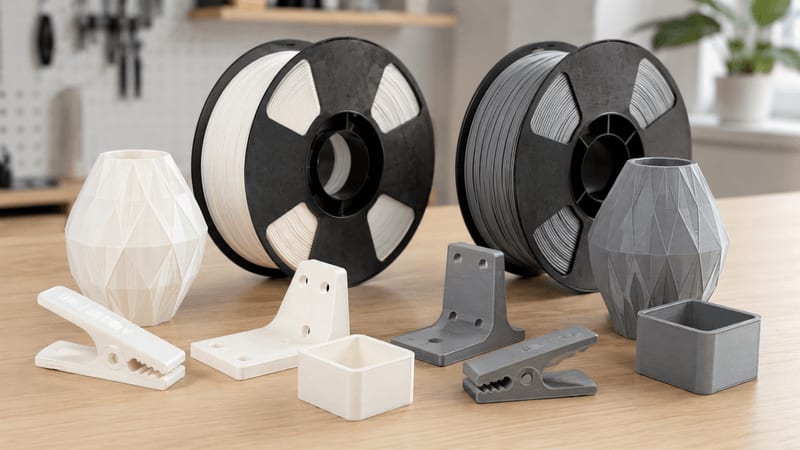
PLA is usually the right first test when appearance, dimensional crispness, low warp, easy support removal, color range, and print speed matter most. It is a strong material for concept models, architectural forms, display samples, educational printing, tabletop parts, jigs with light loads, and fast iteration.
PETG deserves attention when the part will be handled often, exposed to moisture, flexed slightly, clipped into place, or used as a protective guard. It is not automatically stronger in every direction, but it usually gives a more forgiving failure mode than brittle PLA, especially when layer bonding and moisture condition are controlled.
The material decision should be written into the project brief. List load, impact, temperature, moisture, appearance, printer capability, and expected life. If those requirements are unclear, print one PLA sample and one PETG sample using the same geometry, then test the parts rather than debating the names.
Printability and Process Window
PLA has a wide comfort zone. It usually tolerates stronger cooling, prints small details well, bridges cleanly, and is easier to tune on open-frame printers. That is why PLA is often the fastest path from model to acceptable part.
PETG needs a narrower process window. Too much heat can increase stringing and blobs. Too much cooling can reduce layer bonding. Too much first-layer squish can make removal difficult or damage some build surfaces. Retraction and travel behavior need more care because PETG tends to ooze more visibly.
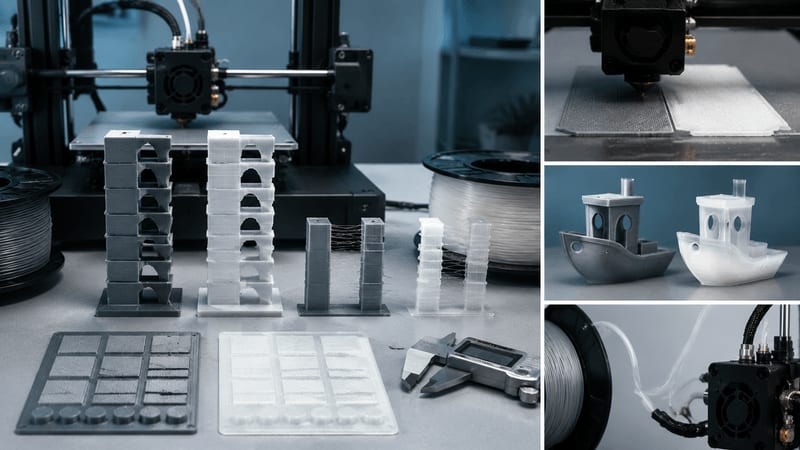
For repeat production, build a profile around the actual machine. A PETG profile that runs well on a direct-drive enclosed printer may not transfer cleanly to a Bowden open-frame machine. Likewise, a PLA profile built for speed may lose edge quality or strength on tall parts if cooling and flow are not balanced.
Process tuning checklist
- Print a temperature tower and inspect gloss, stringing, bridging, and layer bonding.
- Run a first-layer sample and confirm removal after the bed cools.
- Check corners and holes on a dimensional coupon.
- Test the real model with support interfaces if support removal matters.
- Record filament batch, nozzle, bed surface, slicer version, and room condition.
Strength Is More Than a Single Number
PLA is stiff. For many brackets, fixtures, display parts, and prototypes, stiffness is useful because the part holds shape and feels precise. The risk is brittle failure: a thin tab or snap feature may crack suddenly if it is bent too far or hit sharply.
PETG is usually more ductile. It can bend more before breaking and often handles impact better. This makes it useful for clips, containers, guards, handles, covers, cable guides, and parts that receive repeated handling. The tradeoff is that PETG can feel less rigid, and parts may flex more under load unless geometry is designed for stiffness.
Layer direction matters for both materials. A part loaded across layer lines can fail differently from the same part printed flat. If the part is structural, test it in the orientation that matches use. Do not approve strength from a generic printed bar unless the real geometry behaves similarly.
Heat and Environmental Exposure
Neither PLA nor PETG should be treated as a high-temperature engineering polymer. PLA can soften in warm environments, especially under load. A PLA part left in a hot car, near a motor, inside a sunlit enclosure, or under sustained stress can deform even if it looked perfect after printing.
PETG usually offers a better margin for moderate heat and moisture. It is often chosen for containers, guards, brackets, and damp environments because it retains useful toughness and shape in conditions that may be risky for PLA. Still, PETG can also creep under load, so wall design and test conditions matter.
For a real project, test the part under the expected load and temperature. A flat sample coupon is useful, but it does not replace checking the actual bracket, clip, cover, or enclosure.
Surface Finish and Visual Quality
PLA is excellent for appearance. It can produce sharp corners, clean embossed details, low stringing, and a wide range of finishes: standard gloss, matte, silk, marble, wood-filled, glow, rainbow, and multi-color effects. For product photography, design review, and retail-friendly prints, PLA often gets to a polished result faster.
PETG can look rich and technical, especially in translucent or glossy colors, but it may show stringing, fine hairs, surface scars, and nozzle drag more easily. PETG also likes to stick strongly to some surfaces, so first-layer setup affects the bottom finish and removal experience.
If the part is customer-facing, print a sample in the actual color and lighting environment. A gray PETG bracket may look excellent in a workshop but too glossy for a consumer product. A matte PLA prototype may look premium but lack the ductility needed for the final clip.
Moisture and Storage
PLA benefits from dry storage, but PETG usually shows moisture problems more clearly. Wet PETG may pop at the nozzle, create haze or bubbles, produce rough surfaces, and increase stringing. These symptoms can mislead the operator into changing temperature or retraction when the real problem is filament condition.
Store both materials in sealed bags or containers with desiccant. For production, label opened spools, track storage time, and dry PETG when surface quality or strength starts to drift. A print farm should treat moisture control as part of the process, not as emergency troubleshooting.
Dimensional Accuracy and Fit
PLA often feels easier for dimensional work because it is stiff and prints crisply. Holes, edges, and small features tend to be clean when cooling is tuned. That makes it useful for gauges, fit-check prototypes, and appearance models.
PETG can also be accurate, but tuning matters. Stringing, pressure buildup, and glossy surfaces can make small holes or mating edges less predictable. PETG’s flexibility can be an advantage for snap features, but it may require adjusted clearances compared with PLA.
For fit-critical parts, measure the features that matter: hole diameter, tab thickness, wall spacing, flatness, and assembled gap. Keep one approved sample near the printer or QC station so operators can compare future parts quickly.
Typical Applications
Choose PLA for visual models, educational printing, design iterations, display objects, low-load fixtures, architectural models, color-focused prints, and products where crisp detail matters more than ductility.
Choose PETG for protective covers, clips, containers, brackets, damp-area parts, cable management, moderate-impact components, and parts that need more forgiving handling. PETG is also useful when the print should feel less brittle but does not require nylon, ABS, ASA, or carbon-fiber reinforcement.
The gray area is common. A light-duty indoor bracket may work in either material. A product sample may need PLA for appearance and PETG for functional testing. In that case, print both and make the difference visible to the team.
Cost, Color, and Supply Planning
PLA usually offers the broadest finish and color ecosystem. For retail filament brands, PLA is often the easiest category to expand because customers expect standard colors, matte colors, silk colors, rainbow transitions, wood effects, glow effects, and seasonal collections.
PETG color ranges are also strong, but consistency can be more sensitive to processing. Translucent colors, glossy surfaces, and moisture condition can change perceived quality. If the product line includes PETG, approve printed color samples, not only filament strand samples.
For OEM or private-label supply, specify diameter tolerance, spool winding, packaging, desiccant, carton protection, barcode rules, color approval, and retained sample policy. The material choice is only one part of a repeatable commercial product.
A Simple Selection Method
Use this sequence when a team is divided between PLA and PETG:
- Define the most likely failure: cosmetic, dimensional, thermal, impact, fatigue, moisture, or assembly.
- Print the same representative part in both materials.
- Use reasonable tuned profiles, not one default profile for both.
- Test the part after 24 hours, because cooling and conditioning can change feel.
- Compare function, appearance, cleanup time, scrap rate, and customer-facing quality.
- Choose the material that meets the requirement with the widest repeatable process window.
This method is slower than guessing, but it prevents expensive rework when a project moves from prototype to repeat order.
Final Takeaway
PLA is the best first choice for easy printing, crisp presentation, color variety, and fast iteration. PETG is the better default when the part needs toughness, moisture tolerance, ductility, and repeated handling.
For professional use, the right answer is not a slogan. It is a tested system: material grade, printer, profile, geometry, storage method, inspection standard, and approved sample. Once those pieces are documented, both PLA and PETG can become dependable production materials.
Production checklist
- Define load, heat, moisture, appearance, assembly, and expected lifetime.
- Print real geometry, not only calibration cubes.
- Tune PLA and PETG separately; do not force one profile onto both.
- Store PETG carefully and dry it when surface quality changes.
- Approve printed color, dimensions, finish, packaging, and retained samples before repeat orders.